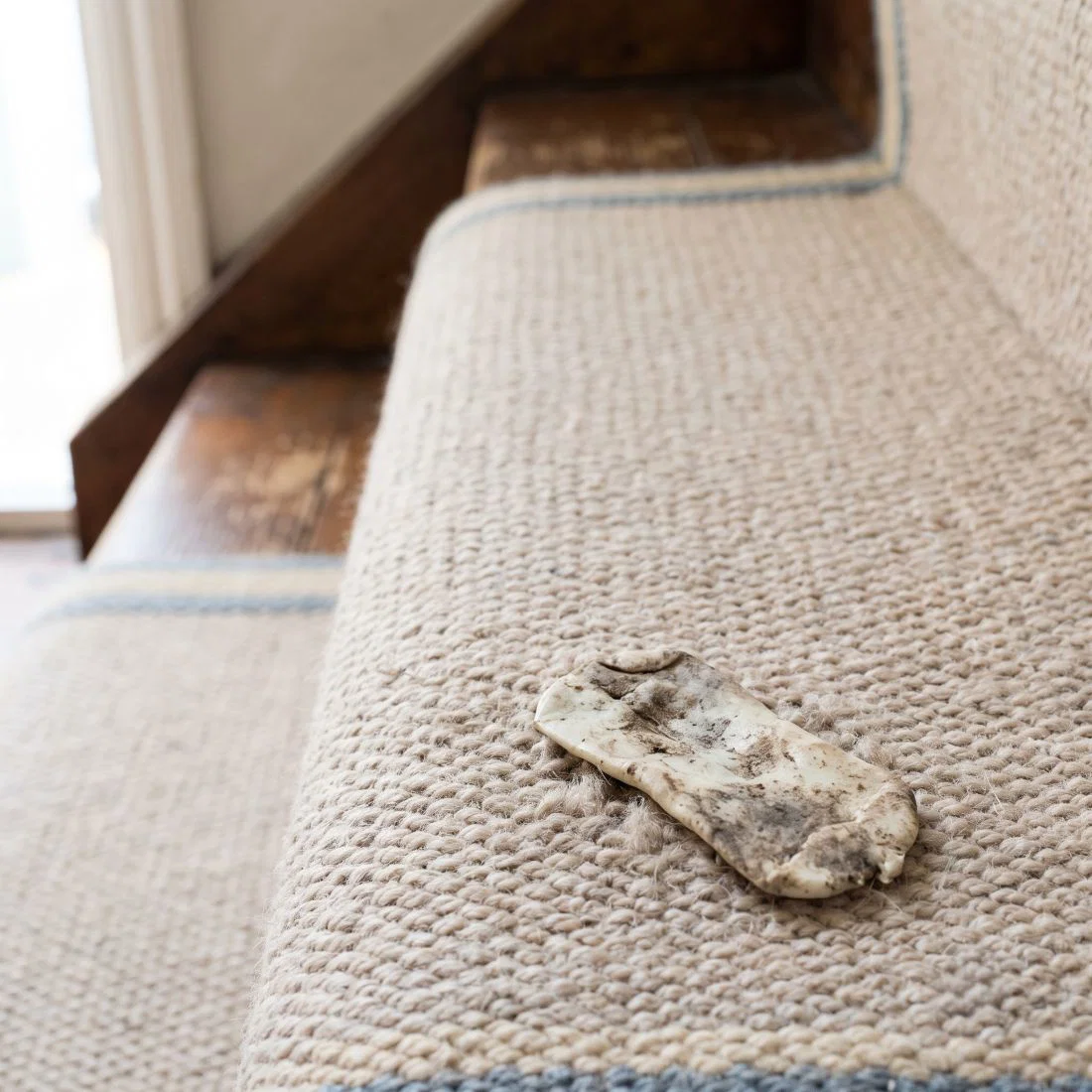
Yes, most of the time, and the failure cases are almost never about the gum.
They’re about what the person did to the carpet while getting the gum out. I’ve lifted gum off eight-year-old wool twist on a Streatham staircase and left nothing behind, and I’ve been called to a Harrow hallway where somebody removed a much smaller piece and left a bald, splayed crater the size of a two-pound coin at eye level on the fourth step. Same substance, same rough approach, and the difference was entirely in how hard they pulled. Don’t pull. That’s the shortest useful advice in this trade.
Why are stairs the worst possible place to find gum?
Because the gum lands where the carpet is already at its weakest and where every visitor’s eye naturally falls.
Gum ends up on the nosing nine times out of ten – the rounded front lip of the tread, where a shoe makes contact first and where the pile has already taken more compression than any other square inch in the house. Stair nosings wear out three to four times faster than the middle of a bedroom floor. By the time gum arrives, the tufts there are shorter, splayed and less able to spring back from any further insult.
The geometry makes it worse. A staircase is viewed from below and head-on, so the nosings present themselves as a stack of horizontal lines at roughly eye height as you approach. A flattened patch in the middle of a room is invisible from the doorway. The same flattened patch on the third nosing is the first thing anyone sees when they walk into the hall. It’s why stair repairs get judged to a standard nobody applies to floors.
There’s no room to work, either. Twenty-two centimetres of tread, a wand that doesn’t fit, and a technician kneeling on the step above with their weight on the very carpet they’re trying not to crush.
The nosing was already halfway gone
Before touching anything I part the pile with a fingernail and look at the tuft density on the nose against the tuft density three inches back on the flat of the tread. On an older stair carpet the nose is frequently down to half the yarn, held in place by neighbouring tufts more than by the backing. Any of those come out with the gum and there is nothing to close the gap with.
Does freezing the gum help?
Freezing is right and the domestic version of it is wrong.
Gum bases are synthetic elastomers – polyisobutylene and styrene-butadiene rubber, mostly – blended with softeners and waxes. They have a glass transition somewhere around minus twenty to minus thirty degrees, below which the whole mass turns from tacky and stretchy to brittle and glassy. Hit that properly and the gum fractures under a blunt edge and comes away in chips that lift off the yarn instead of stretching with it.
A can of aerosol freeze spray gets to minus forty and takes about eight seconds. Ice cubes in a bag reach zero, at best, and while zero makes gum firmer it doesn’t make it brittle, so you get a cold, stiff, still-elastic lump welded to the fibre and a homeowner applying steadily more force. That’s the mechanism behind most of the craters I get called to. And meltwater from the bag soaks the backing at the same time, which softens any latex and makes tuft loss more likely rather than less.
The chips matter. Once the gum is properly brittle you tap it with a plastic scraper or the back of a teaspoon, and it shatters. Don’t pull. Vacuum the fragments as they come away so they can’t be trodden back in on the step below.
Timing helps you as well. Gum that has been walked on for a fortnight has been pressed deeper into the yarn with every footfall and has picked up grit that grinds against the fibre while you work. Same piece of gum, dealt with on the evening it landed, sits mostly on top of the pile and lifts off in two chips. There’s no product that closes that gap. Deal with it the same evening and the whole problem stays small.
What I carry and what it costs
Two cans of freeze spray on the van, about £9 each trade, and a plastic scraper with a rounded corner. That’s the whole kit for a routine gum job. The expensive equipment stays outside. I’ve done gum jobs on a Palmers Green staircase and never opened the van’s rear doors, which occasionally disappoints people who were expecting machinery. The truck-mount is for soil. Gum comes off by hand with a cold can.
When is solvent the right call, and what does it risk?
For the residue, and only for the residue.
Freezing removes the bulk and leaves a thin, greasy film welded into the yarn that reads as a dark shadow on the nosing. That film comes off with a citrus solvent – d-limonene based, applied to a white cloth rather than poured onto the carpet – worked from the outside of the mark inward with light pressure, then flushed with a low-alkaline rinse and dried.
The risk is underneath. Limonene and the aggressive gum removers sold to facilities contractors will soften the latex bonding the primary and secondary backings, and on a stair carpet that bond is doing structural work at the exact point you’re treating. Soften it and tufts release under the next hundred footfalls. The damage shows up a fortnight later as a thinning nose that the customer connects to nothing.
Solvent goes on the cloth. Never more than a few millilitres. Never on foam-backed carpet at all, where it can reach the foam and take the backing apart from the inside with no visible warning until the step feels spongy underfoot.
Sisal, seagrass and the ones I turn down
Natural-fibre stair runners in the Ladbroke Grove and Notting Hill stock get gum too, and the honest answer there is that solvent will ring the fibre and water will stain it. Freeze, chip, and accept the residual shadow, or replace the runner. I say so on the phone rather than after taking the money.
How do you get the pile back once the gum is off?
Moisture, heat and a groom, in that order, and none of it involves a machine.
Compressed and distorted pile responds to controlled steam. The yarn’s memory is in the twist, set at the mill with heat and moisture, and applying both again lets the fibre relax back toward that set. A domestic steam nozzle held four inches from the surface for a few seconds, then teased with a stiff nylon brush against the lay of the pile, recovers a surprising amount. On wool the recovery is better than on polypropylene, because wool’s crimp is a structural property of the fibre and polypropylene’s twist is a heat set that can be lost permanently.
Groom across the nose rather than along it. A pile lifter or a firm brush drawn from the riser up over the nose and onto the tread pulls the splayed tufts back into a vertical stance and makes the boundary between treated and untreated carpet disappear. Don’t pull individual tufts upward with tweezers to “fluff” them, which is a thing people do and which lifts them out of the backing.
A Deptford customer had done the tweezer thing across a whole nosing before ringing me. Nothing to be done with it. The tufts weren’t distorted, they were gone.
Shearing the high ones
Occasionally you finish with a few tufts standing proud of their neighbours, usually where the gum protected them from wear. Sharp scissors, held flat against the surrounding pile as a depth guide, and take them down level. This makes some technicians uncomfortable and I don’t understand why. A carpet is a cut-pile textile and it was cut with a blade in the first place.
When should you cut the gum out, and when should you ring somebody?
Cutting is a legitimate first choice on badly embedded gum in a low pile, and I’ll defend that against most of my own trade.
The prevailing view is that cutting is a last resort and an admission of failure. The prevailing view produces a lot of ruined nosings, because it pushes people into a fourth and fifth round of solvent and scraping on a carpet that was never going to give the gum up intact. Trimming the affected tufts flush with fine scissors takes ninety seconds, removes maybe a millimetre and a half of yarn length across an area the size of a fingernail, and on a nosing that’s already worn shorter than the surrounding carpet it is invisible from any angle. Over-working the same spot for twenty minutes is visible from the front door.
Where the gum has gone right down to the backing and taken tufts with it, the repair is tuft replacement: donor yarn harvested from inside a cupboard or under the bottom stair, threaded through the backing and bonded from beneath. It’s slow, it’s charged by the hour, and on a stair carpet worth £600 it’s frequently worth doing.
The bit that gets skipped: check the riser
Gum on a tread nearly always has a smaller partner on the riser below it, transferred by the same shoe. Check it before you pack up. Half the callbacks I’ve had on gum work were for a second piece nobody looked for.
Here’s what costs me money to write. Fresh gum on a synthetic stair carpet is a job for the homeowner, not for me. Nine pounds of freeze spray, a plastic scraper, eight seconds of cold and a bit of patience will handle it, and my minimum callout charge for a London stairwell is £75 before anyone touches anything. Ring somebody when the gum is old and flattened into a wool nosing, or when a previous attempt has already thinned the pile. Don’t ring for a piece of Wrigley’s that landed on Tuesday.
The Crouch End staircase took eleven minutes. Nine of them were the vacuum.