Two calls in one week last November, both Saturday-night spills, both a full glass of Malbec, both dealt with by a sensible adult who’d looked up the same advice on the same phone.
The Wandsworth flat came out perfectly and the customer cancelled the appointment. The Blackheath house has a pink shadow in the middle of the sitting room that will be there until the carpet is replaced. Same wine, same volume, same twenty minutes of blotting, opposite results, and the only variable that mattered was what the carpet was spun from. Fibre first. Everything after that is detail.
Why does one spill behave so differently on two carpets?
Because one fibre wants to bond with the colour and the other has no way to hold it.
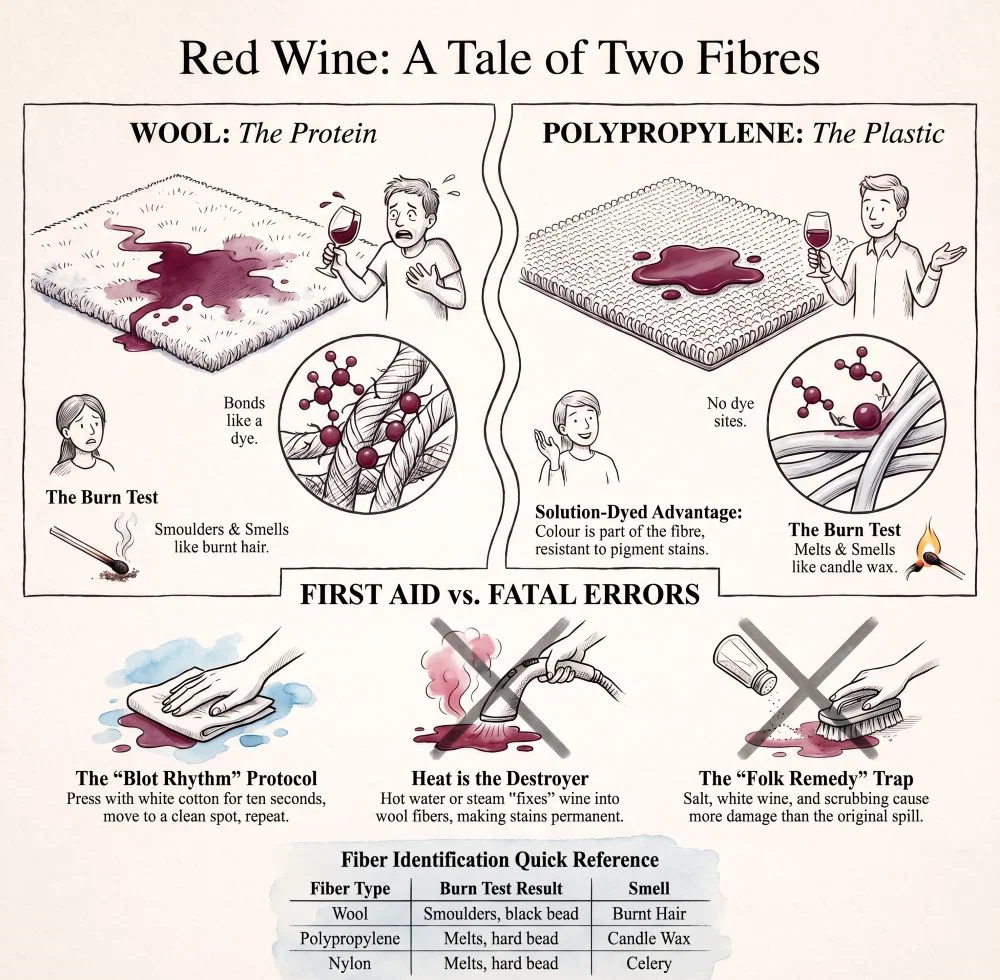
Wool is a protein. It carries amino and carboxyl groups along its length, which is what allows it to be dyed with acid dyes in the first place, and anthocyanin – the pigment doing the damage in red wine – behaves enough like an acid dye to find those same sites and attach. Wine on wool is a dyeing process running at room temperature in your sitting room. Nobody intended it, but the chemistry doesn’t know that.
Polypropylene has no dye sites at all. It’s an olefin, chemically inert, and it can’t be dyed after manufacture, which is why it’s solution-dyed – the pigment goes into the molten polymer before the fibre is extruded, so the colour is part of the fibre rather than attached to it. Wine sitting on polypropylene is wine sitting on a plastic thread. It has nothing to grip. Extract it before it dries and the carpet returns to where it started with almost boring reliability.
Nylon sits between the two and closer to wool, because nylon has acid dye sites as well. A nylon carpet without an intact stain-resist treatment is the worst of the three for wine, and most nylon carpets over about eight years old have lost that treatment to hot alkaline cleaning.
Telling them apart in ten seconds
Pull a single tuft from a hidden edge and put a lighter to it. Wool smoulders rather than burns, smells of burnt hair, and leaves a crushable black bead. Polypropylene melts into a hard bead, drips, and smells faintly of candle wax. Nylon melts too but smells of celery, which sounds absurd until you’ve done it once.
The touch test is less reliable and quicker. Wool is warm and slightly springy under the palm and recovers when you squeeze it. Polypropylene feels cool and a bit waxy, and a crushed handful stays crushed.
What does red wine do to wool?
It goes in fast and it goes in permanently if the first ten minutes are wrong.
Anthocyanins are pH-sensitive, shifting colour from red through purple to blue-grey depending on the environment, and they cross-link over time into a form that no longer responds to the treatments that would have lifted them fresh. Tannins bring their own yellow-brown component. Add the sulphites and the residual sugar and you have three separate staining mechanisms in one glass, which is why wine gets treated as a category of its own rather than as a spill.
Heat is the destroyer. Hot water on wine-on-wool drives the dye into the fibre and fixes it, and the standard domestic instinct – kettle, hot cloth, steam cleaner from the cupboard under the stairs – is the single most common reason a fresh spill becomes permanent. Cool or lukewarm only, on wool, for the first hour.
Alkalinity is the other one. Wool is amphoteric and comfortable at around pH 5 to 8, and it degrades above that. Sustained exposure to pH 10 spotters swells the fibre, roughens the scales and causes irreversible colour change in the carpet’s own dye, so you can end up with a lighter patch where the wine was and no wine visible in it. Fibre first, always, because that pH 10 spotter under the sink is perfectly safe on the carpet in the next room.
Why the professional approach is slow
Wine on wool is worked with a mild acid, a wool-safe reducing agent and repeated small applications with drying between them, rather than one confident soak. In a Muswell Hill dining room in February I made six passes over about ninety minutes on a spill that was four days old and got roughly eighty per cent of it. A seventh pass would have risked the carpet’s own dye. Stopping short is part of the job and it’s the part customers find hardest to accept.
Where does polypropylene catch you out?
Oil, and heat from the machine rather than heat from the kettle.
Polypropylene is oleophilic. It repels water and attracts oils, so while the wine itself comes out easily, the greasy residue from the crisps that went over with it, or the butter on the cheeseboard, sinks into the fibre and stays. Six months later there’s a grey-brown shadow in the same spot and everyone blames the wine. It was never the wine.
The second trap is thermal. Polypropylene softens somewhere around 130°C and melts at roughly 160°C, and a rotary machine run too long in one place on a dry patch generates surface friction heat well inside that range. The result is glazing: a shiny, flattened, permanently altered patch, usually a neat circle, which is a far worse outcome than the stain anyone was trying to remove. It happens most in hallways where the operator lingers on a stubborn mark.
Oxidising spotters, incidentally, are safe on solution-dyed polypropylene in a way they are absolutely not on wool. Hydrogen peroxide at 3 per cent will lift residual wine colour from a polypropylene carpet without touching the pigment, because the pigment is locked inside the polymer. The same bottle on a wool carpet strips the dye and produces a pale halo that no one can put back.
The one bottle I won’t sell to a domestic customer
Peroxide-based spotters get recommended freely online with a line about testing in a hidden area first, and nobody tests in a hidden area first. On wool the damage is instant and structural. I keep peroxide on the van and I use it on synthetics, and when a customer with a wool Axminster in Fitzrovia asks me what they should keep at home for emergencies, the answer is white cotton cloths and cold water.
Which first-aid steps help, and which cause the damage?
Blot with white cotton, working inward from the edge, using cold water only. Weight a folded towel over it and leave it twenty minutes. That’s the entire list of things that help on both fibres.
Salt does very little. It absorbs a small amount of surface liquid and then sits in the pile as a gritty residue that attracts moisture from the air for months afterwards, and the grains abrade the fibre when they’re walked on. White wine over red is a folk remedy with no mechanism behind it – you’ve added a second liquid with its own sugars and a pale yellow tint. Washing-up liquid leaves a surfactant residue in the pile that re-soils faster than anything else you could put down, so the mark comes back darker in six weeks and looks like the wine returning.
Scrubbing is the one that does real physical harm. Wool fibre has a scaled surface that felts under friction and moisture, and a vigorously scrubbed wool carpet develops a permanently fuzzy, matted texture at the spill site whether or not the colour comes out.
The blot rhythm nobody follows
Press, count to ten, lift, move to a clean part of the cloth. Repeat until the cloth stops taking colour. Most people do four blots on the same wet corner of a tea towel and then declare it hasn’t worked, which is fair, because at that point they’re redistributing wine.
What can’t be fixed, and when is it worth ringing anybody?
Dye loss is not a stain, and it’s the distinction that decides everything.
If the wine has been treated with something alkaline or peroxide-based on a wool carpet, the mark may now be an absence of colour rather than a presence of it. That gets corrected by re-dyeing with acid dyes to match, which is specialist textile work, priced per hour, and worth it on a good rug and rarely worth it on a fitted bedroom carpet. Fibre first here too – dye loss on solution-dyed polypropylene barely exists, so a persistent mark on polypropylene is nearly always oil or a residue problem with a straightforward answer.
Age of the spill decides the quote, not the size
The first question on the phone is when, and the answer moves the price more than the square footage does. Under an hour on wool is a routine job. A week is a partial recovery with a written expectation attached. Anything treated by the customer with an unknown product is a job I price with a caveat, because I’m now working on two problems and only one of them is wine, and the second one is invisible until the acid rinse starts pulling colour that shouldn’t be moving. What it’s made of, then how long it’s been there, then whatever’s already been done to it.
The Ruislip job that taught me to ask about the timeline: a two-year-old spill on wool, treated twice by the customer with a supermarket spotter, then left. Six passes and it moved perhaps a third. The honest quote was for a partial improvement and I said so before starting.
Here’s the bit that loses me a callout most weeks. Fresh red wine on a polypropylene carpet does not need a professional. Blot it hard, rinse with cold water, blot again, weight a towel on it overnight, and you’ll be looking at nothing in the morning. Ringing an emergency spot-clean service at nine on a Saturday night for a synthetic carpet is a hundred pounds for something a tea towel handles. Save the call for wool, and make it before you try anything clever.
The Blackheath carpet is being replaced next month. The customer had used boiling water.