The call always comes on a Wednesday or a Thursday, and the voice is baffled rather than angry (though anger is not out of the picture).
The carpet looked fine when the technician packed up. It looked fine that evening. Then somewhere between Monday night and Wednesday morning a tan halo appeared round the edge of the room, or a ring the size of a dinner plate surfaced in the middle of the sitting room where there was nothing at all before. Nobody sees it happen. It arrives during the boring stretch of drying that everybody stops paying attention to, which is exactly why it gets blamed on the wrong things – the detergent, or a mystery spill from three tenants ago.
What is happening in the two days after the technician leaves?
Water is leaving, and it isn’t leaving alone.
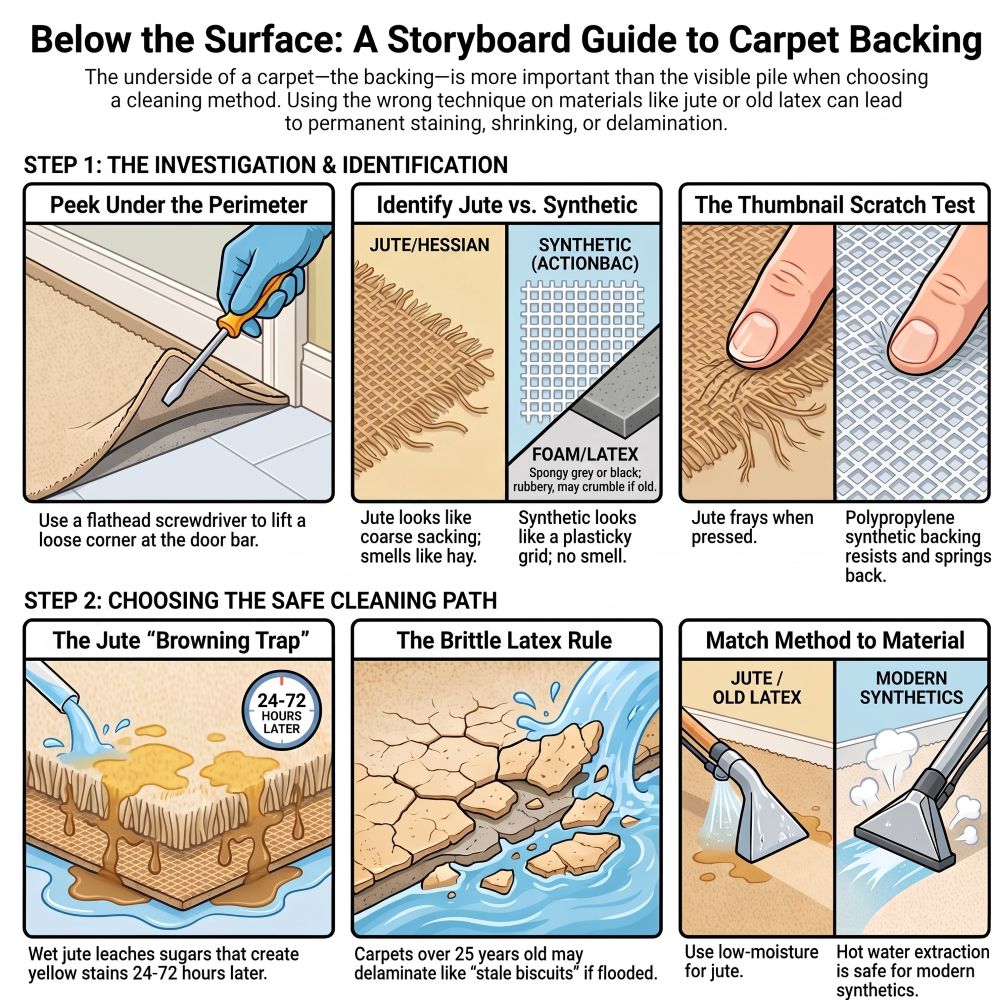
A carpet that has been extracted still holds moisture in the backing and the underlay, and in the top few millimetres of subfloor screed or floorboard. That moisture travels upward by capillary action through the yarn as the surface evaporates, and it carries dissolved material with it. Anything water-soluble sitting below the pile – plant sugars from a jute backing, tannins from an old spill that dried into the underlay, degraded lignin from the felt itself – comes up the fibre like ink up blotting paper and deposits at the surface as the water changes state and goes into the air.
The whole process runs at the speed of drying. Fast drying gives it a window of a few hours and produces very little. Slow drying gives it thirty or forty hours and produces a stain that looks, to anyone standing in the doorway, exactly like something spilled and left.
In Northolt last February I cleaned a landing and two bedrooms in a house where the boiler had failed the previous week and the ambient temperature was ten degrees. Same machine, same chemistry, same technician as the flat I’d done in Enfield the day before. The Enfield job dried in seven hours and did nothing. The Northolt landing took two and a half days and browned along both walls.
Why the edge and not the middle
Airflow collapses at the perimeter. The skirting blocks it, the gripper compresses the underlay so the moisture has a longer path, and the last square foot of carpet before the wall is the last to release its water. Where drying is slowest, deposition is heaviest, so the mark maps the airflow pattern of the room rather than any human event. Move a sofa back too early and you’ll get a rectangle in its footprint for the same reason.
Where does the brown come from?
Jute is the usual suspect and the least interesting one.
Hessian and jute contain lignins and hemicellulose that dissolve in water and oxidise to yellow-tan on exposure to air. That’s the textbook case, it’s real, and it accounts for maybe half the browning I’m called to. The other half comes from places the textbook skips over. Cellulosic fibre in the underlay, particularly the older felt and rubber-crumb composites in properties around Orpington and Sidcup that were carpeted in the eighties and never lifted since. Cardboard packing left under a fitted carpet by a rushed fitter. Sisal or coir stair runners that shed into the landing carpet for a decade. Timber floorboards under a thin underlay, where a soaking clean reaches the wood and pulls tannin straight out of it.
Nobody sees it happen, so nobody connects a stain that surfaces on Wednesday with a subfloor they’ve never looked at.
Alkalinity makes all of it worse. A high-pH pre-spray left to dwell without a proper acid rinse leaves the fibre sitting at pH 9 or 10, and alkaline conditions accelerate the oxidation that turns dissolved sugars visibly brown. A carpet rinsed back to pH 6 dries with the same dissolved material and shows a fraction of the colour.
The neutralising rinse that half the trade skips
An acid rinse costs about ninety pence a room in concentrate. Skipping it saves ninety pence and a tank change. I’ve walked into enough properties in Morden and Sutton where the previous clean was done with alkaline pre-spray, extracted with plain water and left at pH 9.5, and the browning that followed was written off in the report as “pre-existing contamination resurfacing”. It wasn’t pre-existing. It was Tuesday’s chemistry finishing its work on Thursday.
How do you tell browning from an old spill coming back?
Look at the shape and the edges before you look at the colour.
Cellulosic browning has soft, diffuse boundaries and follows drying geometry: perimeter bands, or the outline of whatever was sitting on the last wet patch. Wicked-back spills reproduce the shape of the original event, so you get a splash, a pour pattern, a ring with a defined edge where a glass sat. Urine wicks back with a yellow-green cast and, more tellingly, a smell that sharpens as it dries. Rust from a radiator foot or a metal castor comes back orange with a hard edge and won’t move for any amount of oxidiser.
The other one people miss is oily soil resurfacing, which reads as a grey-brown smudge in traffic lanes rather than a ring, and means the pre-spray didn’t have enough solvent in it for the soil load.
I’ll annoy some of my own trade with this next bit. Browning is nearly always the cleaner’s fault. The standard explanation offered to customers – hidden historical contamination that the clean unfortunately disturbed – is a way of moving responsibility onto the carpet’s biography. The contamination was there on Monday too, and it stayed put, because nobody had made it soluble and given it thirty hours of slow evaporation to travel in. A carpet dried in six hours with a neutral pH does not brown, whatever its history.
The one exception I’ll grant
Flood work is different. A carpet that has sat under a burst washing machine feed for a day before anyone rang has genuine deep contamination in the subfloor, and browning after the restoration clean is a physical certainty rather than a mistake. I say so in advance on those jobs and price a second visit into the quote.
Can it be reversed once it’s shown up?
Usually, and the odds fall the longer you wait.
The treatment is an acid: a citric or oxalic solution applied to the affected area, agitated gently, dwelled for ten minutes, then extracted with a low-alkaline rinse and dried hard with air movement. Acid conditions convert the oxidised compounds back to a colourless form. For stubborn cases a mild oxidising step with hydrogen peroxide at low volume, kept off wool unless you’re confident about the dye system, will pull the rest.
Temperature helps the acid work and hurts everything else, so the solution goes on warm and the room goes cold and windy immediately afterwards. Most failed corrections I’ve been called in to rescue failed at that second step: the right chemistry applied properly, then left to sit in a closed room overnight, which re-runs the original fault with a slightly different colour at the end of it.
Success rates from my own notebook: within a week, ninety per cent or better. After a month, sixty to eighty. After six months on a wool carpet in a sunny room, the oxidation has had UV help and set, and a good result is now a lighter brown rather than no brown.
Nobody sees it happen the second time either, so the reapplication gets blamed for a mark it merely relocated. Reapplication matters more than strength. Three moderate passes with drying between them beat one aggressive soak, and one aggressive soak on a jute-backed carpet re-wets the exact material that caused the trouble and buys you a fresh ring in a slightly different place.
When to leave it alone
A faint perimeter shadow on an eighteen-year-old wool carpet in a rented flat in Peckham does not need a two-hundred-pound corrective treatment. Say so. I’ve talked people out of it and lost the work, and the alternative is charging for chasing a mark that’s visible for four minutes a day when the sun hits the bay window.
How is browning prevented in the first place?
Control the water and control the clock, and the chemistry looks after itself.
Less water into the carpet, more of it back out. Four dry strokes for every wet one on anything with a natural backing. Acid rinse as standard rather than as an upsell. Air movers left running for the first four hours, which is the period that decides everything, and a dehumidifier in any room without openable windows or with an internal drying dead spot. Six hours to dry is safe. Twelve is a coin toss on a jute-backed carpet. Thirty is a stain.
The four hours that decide it
Most of the argument about browning is an argument about the first four hours, and most of it is settled by equipment somebody chose not to bring. A single axial mover in a twelve-square-metre bedroom, set low and aimed along the skirting rather than at the middle of the floor, cuts a twelve-hour dry to about six. Two movers and a compressor dehumidifier in a closed internal room in a Hackney block with sealed windows will do the same. This is unglamorous kit and it is the difference between a job that holds and a phone call on Thursday. If a quote includes no drying equipment and the property has a natural-backed carpet, the price you’re being given is for a gamble.
The bit I’d rather not write down: mild browning is treatable at home. Citric acid powder from a brewing supplier, a tablespoon in half a litre of warm water, a white cloth, blot don’t scrub, then a fan on it for two hours. That fixes a good proportion of the perimeter shadows I get called out to look at, and it costs about four pounds. Try it on a hidden corner first, and don’t do it on silk or a hand-knotted rug.
The Enfield flat is still fine, eighteen months on. Seven hours and three fans.