The bit of a carpet that decides how it gets cleaned is the bit nobody looks at.
Homeowners describe the pile to me over the phone in impressive detail – wool twist, “quite a deep one” – and none of it changes my equipment list very much. What changes the equipment list is the two or three millimetres of woven or bonded material underneath, holding the tufts in place and holding the whole thing flat. Get that wrong and you can turn a perfectly serviceable carpet into a wrinkled, brown-edged apology in about forty minutes. Turn a corner over before you spray anything. It costs nothing and it settles the entire argument.
How can you tell what’s under your carpet without lifting the whole thing?
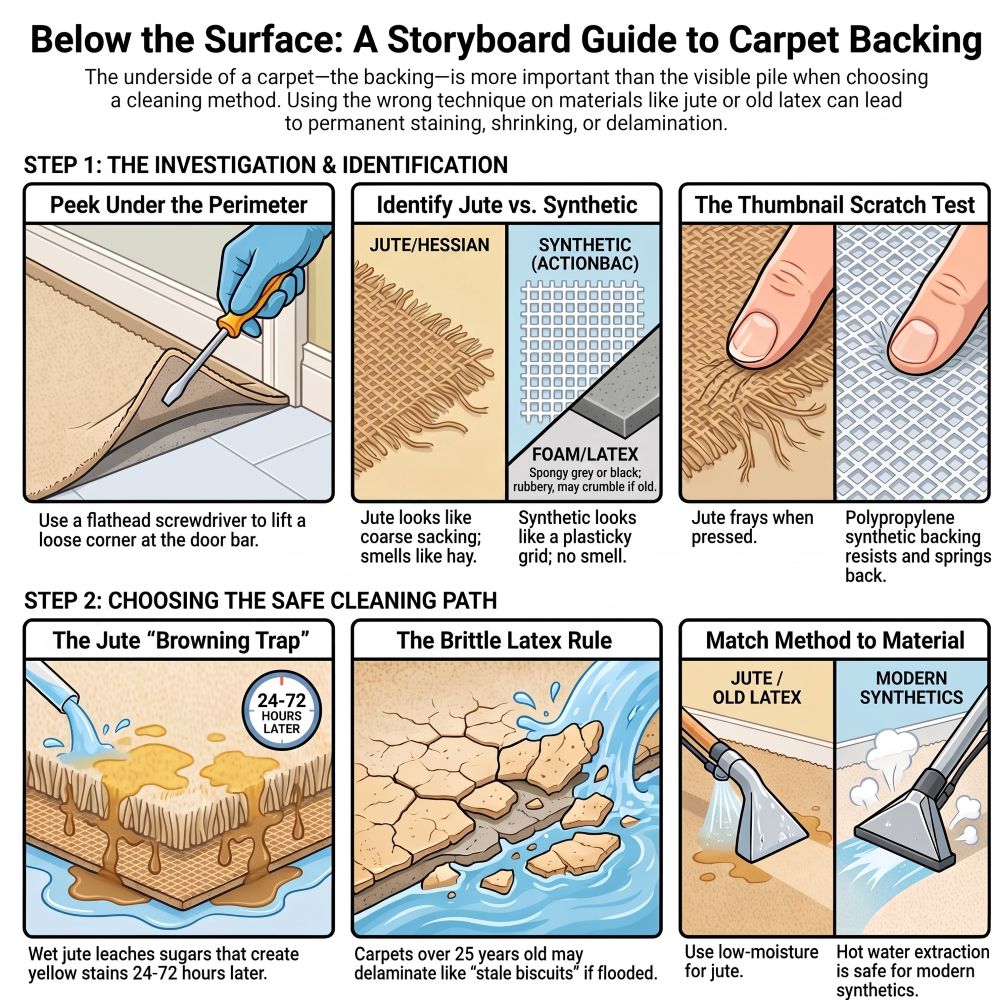
The door bar is your friend. At every threshold there’s a metal or hardwood strip where the carpet is gripped and folded, and at one end of it the fold is nearly always loose enough to lift with a flathead screwdriver and a bit of patience.
What you’re looking for is texture. Hessian and jute secondary backings look like coarse sacking, a visible open weave with a tan or greyish-brown colour and a faint smell of rope and hay when it’s warm. Synthetic secondary backings – polypropylene woven cloth, sold under names like ActionBac – look like a plasticky grid, brighter, with a regular machine-made pattern and no smell to speak of. Latex sits between the primary and secondary layers as a rubbery skim, and on a foam-backed carpet it becomes the whole underside: a spongy grey or black layer with no weave at all.
Age is a decent proxy where you can’t get a look. Wool Axminster and Wilton woven in the seventies and eighties in a Roehampton mansion block will be jute over jute more often than not. Anything tufted and fitted since roughly 1995 in a London new-build is overwhelmingly polypropylene backed with a synthetic latex bond.
The thumbnail test at the skirting
Press a thumbnail into the backing where you’ve lifted it. Jute gives, frays a little, leaves fibres on your nail. Polypropylene resists and springs back. Old latex that’s gone past its life crumbles into a fine grey dust that gets on everything, and if you’re seeing that dust you have a delamination problem waiting to happen regardless of what anyone does with a wand.
Why does jute punish wet cleaning?
Because jute is a plant, and plants leach.
Jute and hessian are cellulosic, packed with lignins and natural sugars that stay water-soluble for the whole life of the material. Wet that backing thoroughly and those compounds dissolve, then follow the water as it evaporates upward through the pile, and they oxidise on the way to a yellow-tan discolouration that shows worst along the perimeter and under anything that slowed the drying. The pile itself hasn’t stained. The stain arrived from underneath, which is why it laughs at spot cleaner.
There’s a timing trap in it as well. Browning rarely shows on the day. It develops over the twenty-four to seventy-two hours after the clean, as the last of the moisture works its way out of the perimeter, so the customer signs off on a carpet that looks fine and rings on Thursday to report a stain that arrived by itself. By then the cleaner who caused it has been paid and moved on to a job in Croydon.
The second problem is dimensional. Jute swells across the weave when saturated and contracts hard as it dries, and it doesn’t return to precisely where it started. On a fitted carpet stretched over gripper rods that shows up as ripples across the middle of the room a fortnight later, at which point everyone blames the fitter. On a loose rug it shows up as the edges cupping.
A Herne Hill client had a wool Wilton in a bay-windowed front room that a general cleaning firm had wet-vacuumed with a domestic machine, twice, on the basis that twice must be better than once. The browning ran in a band eighteen inches deep round three walls. We pulled it back with a mild acid rinse and an oxidising treatment over two visits, and it’s ninety per cent gone, which is the honest ceiling on that kind of recovery.
Why the tide-mark hugs the skirting
Perimeter drying is slower than field drying because the airflow dies at the wall and the underlay is compressed under the gripper. Slow drying means a longer window for dissolved sugars to migrate and set. Turn a corner over on a browned carpet and you’ll usually find the backing itself is a shade darker where the mark is worst on the face.
What does a latex secondary backing change?
It removes the browning risk almost entirely and introduces a different one.
Synthetic latex and polypropylene don’t dissolve, don’t leach and don’t swell, so a modern tufted carpet in a Bow warehouse conversion can take a proper hot-water extraction at 55 to 60°C with an aggressive rinse and come up clean with no perimeter risk at all. This is the part of the trade that gets over-complicated by people selling caution. On a five-year-old polypropylene-backed carpet you can be generous with water, and being generous with water is how soil leaves a carpet.
The risk is delamination. That latex bond has a service life, roughly fifteen to twenty-five years depending on the mill and the amount of UV and heat it’s lived under, and once it’s gone brittle the primary and secondary layers separate. Heat and moisture accelerate the last stage of that. A carpet in a converted flat off Roman Road that has spent two decades over a south-facing bay will have latex the consistency of stale digestive biscuit, and flooding it will produce bubbling and a hollow, rustling sound underfoot that no amount of drying reverses.
The three-decade rule and why I ask about the vendor
Any fitted carpet over about twenty-five years old gets treated as brittle-latex until proven otherwise, whatever the backing type. I ask when the carpet went down and I ask who lived here before, because “it came with the house” and “we put it in ourselves in 2019” are answers that lead to two different machines coming off the van.
Which method suits which backing?
Woven jute-backed wool, fitted: low-moisture work only in situ. Rotary or oscillating pad with a solvent-light detergent, minimal water, no perimeter saturation, air movers immediately.
Woven jute-backed wool, loose rug: off site, full immersion or controlled shower wash on a hard floor with a wringer and a rack, dried flat under moving air within four to six hours. That’s the whole point of a plant.
Polypropylene or ActionBac secondary, any age under twenty years: hot-water extraction, and use the water.
Foam or rubber backed: extraction at reduced flow, more dry passes, never a saturating pre-spray, because the foam holds water in a closed cell structure that has nowhere to go but up through the pile over the following three days.
I part company with a chunk of the industry here. Jute-backed woven wool fitted carpet should not see an extraction wand in a domestic room, full stop, no matter what the mill’s care leaflet says about warm water at moderate pressure. The leaflets were written by people testing on new samples in a controlled room, and the carpet in your Kingston dining room has had thirty years of subfloor dust, pet accidents and one radiator leak nobody mentioned. I’d rather clean it twice with a pad than once with a wand and spend the following month arguing about a brown line.
Rugs are a separate trade and should be priced as one
Anyone quoting the same square-metre rate for a jute-foundation rug as for a fitted synthetic carpet has stopped thinking. The rug needs collection, a wash floor, a wringer or centrifuge, controlled drying and delivery, and if it can’t have those things it needs a method so gentle that the honest description is a surface freshen rather than a clean.
When does backing type change the quote?
More than the pile fibre does, and it’s the question fewer people ask when they’re ringing round for prices.
Jute-backed fitted work runs slower per square metre – more passes and more drying equipment left behind, sometimes a second visit – so a Clerkenwell flat with eighty-year-old woven wool in two rooms will price above a same-size Clerkenwell flat carpeted in 2021, despite being the smaller job on paper. Brittle latex means I may quote with a written exclusion for delamination, which sounds like a dodge and is the only responsible way to touch a carpet whose bond has already failed.
The exclusion clause nobody reads
A quote that mentions delamination, browning or shrinkage risk in writing is a quote from someone who has looked at your carpet. The ones that arrive as a flat rate per room with no site visit and no questions about age are pricing an average, and averages are fine until your carpet turns out to be the outlier holding thirty years of jute together with perished rubber. I’d read the exclusions before the price. A Tooting landlord sent me three competing quotes last autumn to compare, and the cheapest of the three said nothing about the backing at all on a property where the sitting-room carpet was plainly pre-1990 woven wool. He went with the middle one.
And the part that undercuts my own invoice: the majority of London carpet I’m called to is polypropylene-backed, synthetic-pile, under fifteen years old, and none of this applies to it. It will take hot water, a strong alkaline pre-spray, four dry strokes and a fan, and it will look new by teatime. If you’ve been told your ordinary bedroom carpet needs a specialist protocol and a premium rate because of its backing, turn a corner over and look. The grid pattern means you’re being sold caution you don’t need.
The screwdriver lives in my top drawer with the moisture meter. It gets used first.