Every third job in a house with underfloor heating starts with the same question, usually asked while I’m still dragging the hose reel through the front door. Should I have left it on?
The answer people expect is yes. Heat dries things. The floor is warm, the carpet sits on the floor, therefore warm carpet dries quicker and everyone goes home pleased with themselves. Reasonable chain of thought, and it comes apart at the second link, because a fitted carpet is by design and by British Standard an insulator laid directly over your heat source. What you do with that thermostat in the twenty-four hours either side of a hot-water extraction matters more than most homeowners think, and the correct answer shifts depending on whether there’s 65mm of screed under your feet or a 200-watt electric mat stapled to plywood.
Does underfloor heating help a carpet dry faster?
A little. Less than the heating bill would suggest.
The whole system is calibrated around resistance to heat transfer. Carpet and underlay over underfloor heating are supposed to come in under a combined 2.5 tog, which in practice means something like a 1.2 tog carpet over a 0.8 tog underlay, and every fraction of tog is a fraction of thermal energy the manufacturer has deliberately stopped from reaching the room. The screed can be sitting at 40°C and the pile surface will still be capped somewhere near 27°C, because BS EN 1264 says so and because your feet would object otherwise. That gradient is the point of the product.
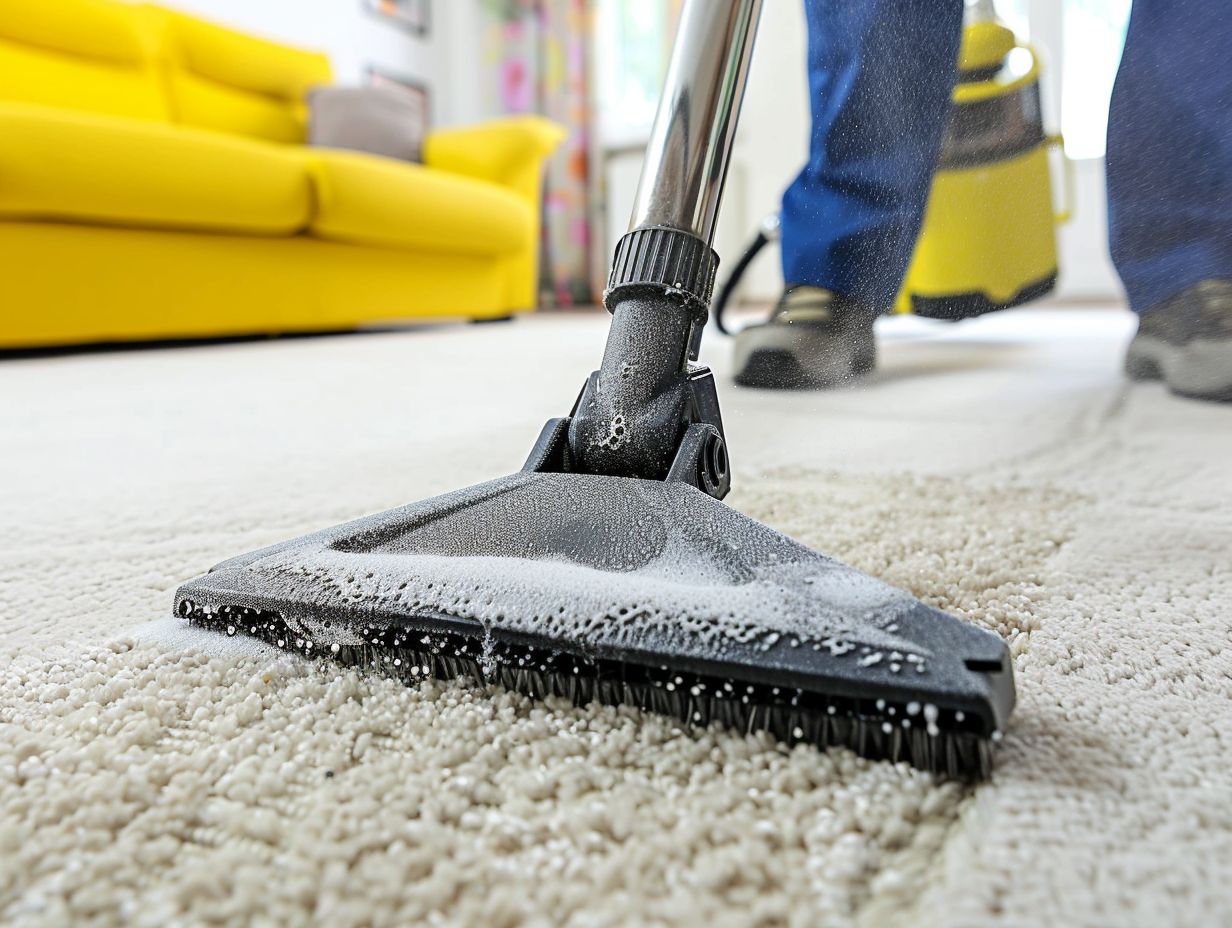
When I flood that pile with rinse water at 60°C and lift 80 per cent of it back out, what’s left is roughly 250 to 400 millilitres per square metre held in the fibre, the backing and the top skin of the underlay. Heat arriving from below has to travel through the underlay first, and the underlay is the densest barrier in the stack. It warms the felt. The felt then very slowly gives that warmth to the primary backing, which gives it to the yarn, and by the time it reaches the tips of a twist pile the temperature differential doing the evaporating is small enough that a £40 axial fan pointed across the surface will outperform it three times over.
Air movement beats bottom heat on wet carpet. That’s not me being difficult – it’s what the moisture meter says on every job where I’ve bothered to run the comparison in two halves of the same room.
What the floor probe reads versus what the pile holds
The floor sensor buried in the screed is measuring screed. It has no opinion about your carpet. A client in Stanmore once showed me his app reading 38°C as proof the carpet must be nearly dry, and the pinless meter I ran across the same square metre was reading 22 per cent moisture content four hours after extraction. Two accurate numbers, describing two different objects, separated by eleven millimetres of bonded polyurethane.
Should the heating be off before the technician arrives?
For a wet system in screed, yes – off a full twenty-four hours before I knock.
Screed carries enormous thermal mass. A 65mm sand-cement pour over insulation board holds heat like a storage heater and sheds it over the better part of a day, so turning it off as I unload the van achieves close to nothing. The floor will still be releasing warmth into the underside of a saturated backing all afternoon, which is the exact condition I’m trying to avoid while the fibres are open and swollen.
Twenty-four hours off, clean, then leave it off for another twenty-four while the pile dries in moving air. Back on gently the following evening, one degree at a time on the flow temperature if the system allows it, rather than a jump from cold to 45.
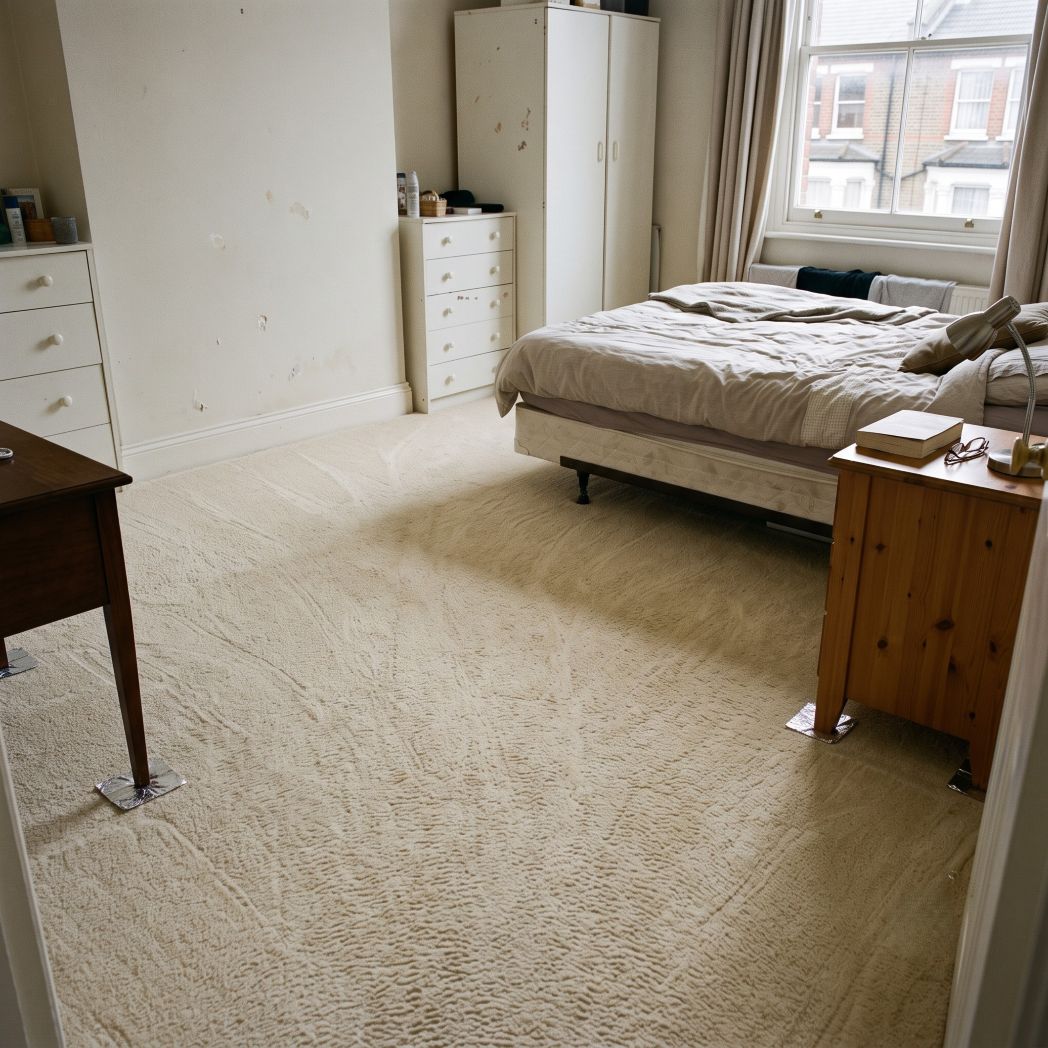
I’ll say the thing that costs me the occasional booking: if a carpet needs your heating system in order to dry, it was cleaned too wet. Vacuum passes are free. A technician who’s dry-stroking properly leaves a carpet that dries in six to eight hours in an ordinary unheated London flat with a window cracked, and the ones who lean on the customer’s underfloor heating to bail them out are covering for a weak recovery stroke.
The awkward gap in a Highbury conversion
Flats are where this advice runs into reality. A first-floor conversion off Aberdeen Park had wet UFH serving the whole floorplate on one zone, February, elderly resident, and no chance of switching the heating off for two days. We cleaned one room at a time across two visits and ran three air movers with a small LGR dehumidifier in the hallway, while she slept in the unheated back bedroom with a plug-in oil-filled radiator. Cost her more. Worked.
What goes wrong when people turn it up instead?
Someone always turns it up. They mean well.
The failure modes stack up in an order. First is speed of surface evaporation exceeding the rate at which moisture migrates through the backing, which draws whatever is sitting in and under the carpet upward and leaves you with tide-marks along the perimeter and shadowing under furniture that wasn’t there before the clean. Reversing that means re-wetting and pulling it back down, which is another appointment and another day of drying.
Second is adhesive. Seam tape on a fitted carpet, and the latex bonding a secondary jute backing to the primary, were never specified for sustained contact heat plus moisture at once. Individually they cope. Together they soften, and a seam that has sat flat for nine years starts to peel at the join under a hot, damp compression cycle. I’ve seen it twice, both times in hallways, both times where someone had wound the stat to maximum overnight in a well-intentioned attempt to speed things along.
Third is smell. A warm damp screed with any history of a slow leak will start venting whatever’s living in it through the only permeable surface available, and that surface is your carpet.
Wool rugs are worse than fitted carpet here
Loose-laid rugs over underfloor heating are the ones that come back to bite. Hand-knotted wool over a hot floor dries from below at a rate the foundation cotton can’t match, the warp tension goes uneven, and you get banding and a ripple through the field that wasn’t in the rug when it came off the van. A Chislehurst customer with a Bidjar in a garden room set his mats to 28°C to “help” after we’d surface-cleaned it in situ. The rug now sits with a two-inch lift down one side. Rugs go back to the plant, dry flat on a rack, and come home when they’re finished. Controlling the drying gradient on a textile with no fixing to the floor demands a rack and a dehumidified room, and that’s not me being difficult either.
Does the type of system change the answer?
Substantially, and this is where blanket advice from a call centre falls over.
Electric mats have almost no thermal mass. A 150W/m² mat under 6mm of levelling compound in a Pinner loft conversion responds within twenty minutes and cools nearly as fast, so off two hours before and back on four hours after the pile feels dry to the back of the hand is fine. No twenty-four hour ritual required.
Wet systems in screed are the twenty-four hour case. Wet systems in low-profile overlay boards – the 15 to 18mm grooved insulation panels with an aluminium spreader plate, common in every Victorian first-floor retrofit from Ealing to Walthamstow – sit between the two. Four to six hours off beforehand covers it, because there’s insulation directly beneath the pipe and very little mass above it.
Nobody knows which system they have
Most people don’t, and there’s no shame in it if you bought the house with it already in. Two quick tells: if the manifold is in a cupboard with visible plastic pipe loops and a pump, it’s wet. If the only hardware is a thermostat on the wall with no manifold anywhere, it’s electric, and it’s probably confined to a bathroom or a single room. Photograph the manifold and send it over with the booking.
What should you ask a cleaner before you book?
Ask whether they’ll take moisture readings before and after, and with what. A pinless meter across a dozen points beats an opinion.
Ask what they bring for drying – air movers and a dehumidifier, or nothing and a hopeful expression. Ask them to specify the flow temperature they want your system reduced to rather than accepting “turn it off” as a complete instruction, because on a wet system that phrase means something different in July than it does in January.
The zone map matters more than the postcode
Ask which zones share a thermostat, because that decides how the job gets sequenced. Open-plan ground floors in the newer Barnet and Colindale developments frequently run kitchen, dining and living area off one loop, which means the carpeted third of that space can’t be isolated from the tiled two thirds. In a Bexleyheath semi last spring the sitting room had its own zone and its own stat, and the whole exercise took one text message the day before. Same job, same equipment, half the negotiation. Find out which house you’re in before you book a date, not on the morning.
Then the part I’m supposed to leave out. The “underfloor heating protocol” surcharge that appears on some London quotations, forty or fifty pounds for a bit of thermostat management, is mostly theatre. Switching a stat off a day early is something you can do yourself, for nothing, in about nine seconds. What you’re paying a professional for is extraction technique and drying equipment. If the quote itemises a UFH fee and doesn’t mention air movers, you’re buying the wrong half.
The Winchmore Hill hallway took nine hours with the heating off and one air mover aimed along the skirting. Nobody froze.